


Data Breach Notification,
Data Privacy,
Data Security
HHS Launches New Enforcement Program to Uphold Patient Confidentiality in Line with HIPAA
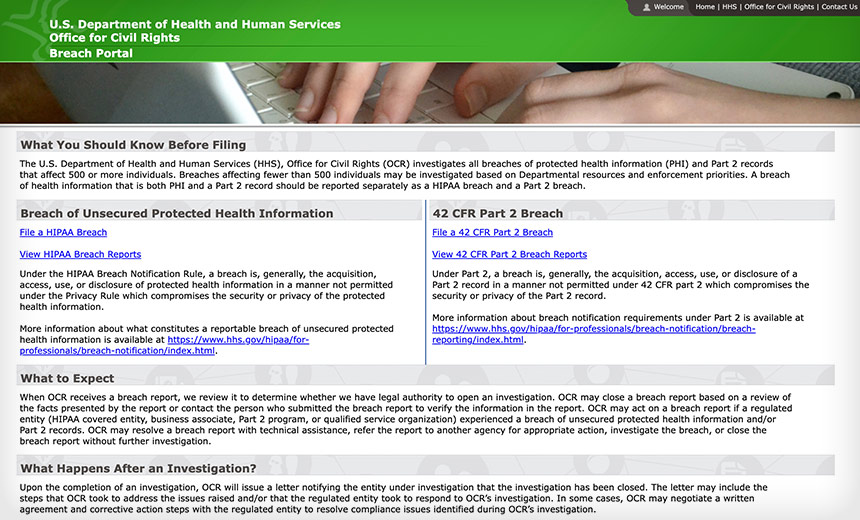
The U.S. Department of Health and Human Services (HHS) has implemented a new program along with a dedicated breach reporting website aimed at enhancing enforcement measures for the protection of substance use disorder records as of Monday. This initiative signifies a shift in how such confidential information is handled under the regulations set forth by 42 CFR Part 2.
According to HHS’ Office for Civil Rights (OCR), this new program has been termed a “landmark” for civil enforcement that seeks to uphold patient confidentiality in treatment contexts. The enforcement capabilities now include the power to impose civil monetary penalties and to forge resolution agreements for non-compliance.
Potential penalties for breaches that involve patient records are governed by the same framework as HIPAA breaches, which ensures that accountability is maintained across both regulatory structures. In a recent statement, Paula Stannard, HHS OCR director, emphasized that this civil enforcement initiative will bolster patient confidence and promote increased treatment access within compliant healthcare settings.
42 CFR Part 2 governs any federally funded programs that provide treatment for substance use disorders, dictating strict privacy requirements. Additionally, these regulations extend to any organization that receives Part 2 records, ensuring comprehensive protection for patient data even when shared among various entities in the healthcare system.
In an effort to modernize these rules, HHS finalized revisions in 2024 aimed at better aligning Part 2 with HIPAA and the HITECH Act—changes prompted by the CARES Act enacted in March 2020. The objective was to enhance care coordination among providers while still safeguarding patient privacy and confidentiality.
The updated regulations also empower the public to lodge complaints regarding alleged violations of Part 2 confidentiality, reinforcing the importance of this legal framework. The establishment of a new breach reporting portal enables organizations to submit breach notifications concerning compromises involving 500 or more patients, as mandated for HIPAA breaches.
Notably, compliance deadlines for Part 2 programs were established for February 16, necessitating that organizations update their privacy notices and consent provisions to reflect these comprehensive changes. However, experts have noted that certain details within the new compliance requirements remain ambiguous, warranting further guidance from HHS OCR.
The new regulatory environment raises questions about how easily organizations can adapt to conform to the updated privacy stipulations, particularly when distinguishing between HIPAA and Part 2 breaches in the context of general healthcare data reporting. There are indications that HHS OCR has been expanding its oversight, forcing it to contend with a rising number of compliance challenges. As investigations into Part 2 breaches unfold, the complexity of concurrent HIPAA regulations could hinder effective enforcement.
As organizations navigate this evolving landscape, clarity will be crucial for compliance and maintaining patient trust. In this context, understanding adversarial tactics, such as initial access and privilege escalation as outlined in the MITRE ATT&CK framework, can serve as a valuable tool for organizations to assess their security posture against potential breaches.